

Cement grout-special
Description
Cement grout-special
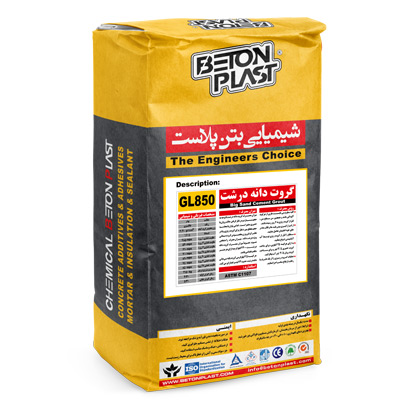
The special cement base grout is composed of cement, aggregated aggregate, powder lubricant, polypropylene fibers and expanded materials. This product has a much higher strength than building mortar and in addition to having high strength, it is used for installing columns plate due to having special formulations.
Features:
- Increases compressive strength of 60 to MPa
- Controlled expansion (volume change)
- Protection of rebars and reinforcements against corrosion
Applications:
- Suitable for filling the empty space between column plate and foundation
- Suitable for implanting anchor bolts and foundations of fences
- Ability to implant rebar up to 8 cm diameter
Technical specification table :
| state of | powder |
| Color | Gray |
| Specific gravity (in paste form) | gr/cm3 6/1 |
| Standard | ASTM C 1107 |
| Chlorine ion | does not have |
Package:
25kg bag
Product Description – Special Cement Grout
The most important and sensitive area in steel structures is their installation and fixation on the foundation base plates. The installation of the base plate on the foundation must be carried out without errors in the installation and by considering all the relevant points and details. After installing the base plates by anchor bolts and tightening the nut and leveling the surface of the base plate and ensuring that the plates are properly fixed in place, according to the execution plan, finally pouring mortar under the base plate is the most important task to complete the process of installing the base plates on the plate. The use of ordinary mortars or concretes is not a suitable option due to the lack of sufficient strength and also their shrinkage due to the loss of mixing water during the setting process and can cause the structure to settle due to the loss of water and shrinkage. To solve this problem, ready-made mortars without compaction and strong construction, called cement grout, have been formulated and produced. Cement-based grouts are much more powerful than construction mortars and, in addition to having high strength, in terms of their special formulation, they create special properties for installing column plates. Cement grout, due to its controlled expansion property, will turn into a homogeneous mortar with good and high strength after adding a certain amount of water. Special cement-based grout, in addition to having higher strength, also has a desirable fluidity. This makes it easier for the mortar to flow under the support plates. Also, in the formulation of cement grouts, materials have been used that increase the volume of the mortar, which this special property compensates for the decrease in volume resulting from cement hydration and prevents the mortar from shrinking and shrinking after drying. This parameter is very important in installing and fixing the support plates on the foundation. Powdered lubricants have been used in the composition of cement-based grout, which in addition to creating fluidity in the mortar, ultimately provides higher resistance due to its water-reducing property. Also, the fluidity of the grout will ensure excellent flow of the mortar to distant points and easier filling of sections with high reinforcement density without the need for a vibrator. Cement-based grout is more efficient than ordinary mortars in filling sections in a paste state and has high resistance to temperature changes.
Cement grout is a type of mortar formulated to fill and stabilize voids, cracks, and install bases for heavy machinery and structures. Special cement grout has improved properties compared to regular grouts. Cement grouts usually have additives that increase resistance to corrosive agents. It can also be said that this type of grout has higher compressive and tensile strength than regular grouts. Cement grout is more durable against environmental conditions.
Special cement grout maintenance
What are the principles for maintaining special high-strength cement-based grout?
Duration: One year in original packaging.
Conditions: Keep away from cold and frost, heat and direct and prolonged sunlight.
The best storage temperature is: +10 to +30 degrees.
Consumption of special cement grout
What is the recommended amount of special cement-based grout?
By calculating the cross-sectional volume and taking into account the specific gravity of the prepared cement-based grout, the amount of grout consumption can be determined, but generally the amount of grout used is 2350 kilograms per cubic meter of space. Each 25-kilogram bag of special cement-based grout fills about 13 liters of space.
Special cement grout packaging
How is special cement-based grout packaged?
25 kg bag
How to use special cement grout
What is the method of using special cement-based grout?
- In the first step, make sure the plates are in place and, if necessary, check the flatness of the base plates using a level.
- Surfaces that need to be grouted must be at least 7 days old.
- The distance between the bottom of the plates and the concrete surface must be at least 1 centimeter.
- All surfaces of sections that will be in contact with grout must be free of any contamination, grease, oil, dust, etc.
- If there are loose or flaking spots on the concrete surface where the grout is applied, they should be removed by submersible or water jetting, or any other physical operation, to the extent that a durable and reliable surface is achieved.
- The molds intended for grouting must be impervious to water leakage.
- The height of the molds intended for grouting should be 2 to 5 centimeters higher than the base plates.
- To prevent the formation of bubbles when pouring grout paste as a fluid in large-volume grouting, use a head box, and in small-volume grouting, use a sheet 50 cm wide, the length of which is the same as the mold wall, at a 45-degree slope in the area intended for pouring, so that the grout fluid moves evenly and continuously.
- The surface to be grouted should be irrigated with drinking water before grouting so that the grout water is not absorbed by the dry surface and cracks after application.
- Choose a suitable container for mixing ready-made grout powder with water that has the appropriate capacity to mix a bag of grout with water.
- To make paste grout, 3.5 liters of water are required, and to produce flowable grout, 4.5 liters of water are required per 25 kg bag.
- Slowly add the powder to the water while the electric mixer (drill + blade) is on and continue mixing until a homogeneous mixture is obtained.
- Be sure to always mix an amount of grout powder with water that can be used within 30 minutes of mixing.
- Please note that adding any additives or cement and aggregate to the ready-made grout mixture is not permitted.
- Grouting operations should always be done from one side and flow to other points under the weight and pressure of its fluidity, and for better flowability, a metal rod or chain can be used as an aid. If the cross-section is large, the fluid pressure can be increased by increasing the height. For grouting very large sections, it is better to divide the desired section into smaller sections using temporary molds.
- Note that excess air can be prevented from being trapped by providing adequate clearance under the base plates.
- The ambient temperature during grouting should be between 5 and 30 degrees Celsius. Temperatures above 30 degrees will accelerate setting, and temperatures below 5 degrees will delay the initial setting of the grout.
- Note that in hot and cold weather, grout powder should be kept in its original packaging and in a covered space.
- It is recommended to use cold water for mixing in hot weather conditions to balance the internal temperature of the grout, and to use warm water for mixing in cold weather conditions.
- After grouting is complete and the grout has reached its initial setting, it is recommended to cover the mold and tools with a layer of wet burlap and to prevent the evaporation of water inside the grout, cover the surface of the burlap again with nylon. After grouting, surface curing should be done for 7 days.
Properties and effects of special cement grout
How do the properties and effects of special cement grout occur?
- Tolerance and stability against grout deformation against loads up to 200 degrees Celsius
- Increasing the efficiency of mortar in a paste state
- Achieving a compressive strength of 60 MPa
- Reduced permeability and water absorption
- Protection of rebars and reinforcements against corrosion
- Achieving high mechanical resistance
- Ability to operate the structure faster
- Ability to control plastic shrinkage of concrete through gas expansion
- High resistance to freeze and thaw cycles
- High resistance to weather conditions
- Has controlled expansion (volume change)
- No cracking due to shrinkage and shrinkage
- No steel rust due to the absence of iron aggregates and chlorides in the cement grout formulation.
- Resistant to high static loads
- No cracking after the mortar hardens.
- Achieving early initial strength without the need to use setting accelerators
- Pumpability and flowability of grout
Applications of special cement grout
What are the uses of special cement-based grout?
- Installation of industrial machinery such as generators, turbines, compressors, diesel engines, and generally machinery that is subject to vibration.
- Suitable for filling the empty space between the column plate and the foundation.
- Suitable for planting anchor bolts and fence posts.
- Installation and fixation of column plates of steel frame buildings
- Suitable for grouting bridge foundations and filling the empty space between the column and the bridge.
- Ability to use special cement-based grout mortar as ready-mixed mortar in general and interior building work
- Suitable for grouting around water pipes passing through concrete walls, as a waterproof mortar.
- Ability to plant rebar up to 8 cm in diameter with cement grout
- Possibility of grouting under conveyor rails in industrial plants
- Possibility of using grout as a repair mortar in deep sections
- Injection under buildings and base plates
Table of physical and chemical properties of special cement grout
Physical and chemical characteristics of special cement-based grout
What are the physical and chemical characteristics of special cement grout?
| Title | Feature |
| Mode | Powder |
| Color | Gray |
| Specific gravity | 2/35gr/cm3 |
| Standard | ASTM C 1107 |
| Chlorine ion | No |
Mechanism of action of special cement grout
What is the mechanism of action of special cement grout in improving the performance of cement structures?
Special cement-based grout is modeled and produced from cement, granulated aggregate, powdered lubricant, polypropylene fibers and expanding materials, each of which has its own effect on improving the properties of the mortar and making the ready-made grout mortar stronger than ready-made construction mortars. The presence of aggregate with a certain amount will make it possible to make a strong mortar with controlled granulation without soil. The presence of powdered lubricants in the formulation of cement-based grout will cause the grout to need less water to turn into paste and mortar, which will ultimately increase the fluidity, as well as the compressive strength and other mechanical strengths. The polypropylene fibers present in the grout structure also play an important role in the form of cement grout by increasing the abrasion resistance and improving some of the mechanical properties of the mortar. Special expansion agents, or shrinkage-compensating agents, in grout provide one of the most important special properties of grout, namely, non-shrinkage and compensation for the decrease in volume of the mortar due to hydration and water loss. Also, the use of this product prevents cracking after the mortar hardens.
Special cement grout safety
What are the safety conditions when using cement-based grout?
- This material is not toxic, flammable, or environmentally hazardous.
- In case of accidental contact with skin or eyes, wash with fresh water.
- If swallowed, seek medical attention immediately.
- Avoid direct breathing when mixing grout.
- Be sure to wear appropriate gloves, safety glasses, and a mask.
Special cement grout standard
Which global standards are used to measure special cement grout?
ASTM C 1107 standard
Special cement-based grout price
Factors affecting the price of special cement-based grout:
Quality of raw materials : The type and quality of cement, silica, and other additives can have a big impact on the price of grout . Higher quality grouts usually cost more.
Strength and technical properties: Grouts with special strengths and no shrinkage usually have a higher price. These properties allow the grout to be used in special situations such as under the surface of columns and in sensitive projects.
Purchase volume: Bulk purchases usually come with greater discounts. Therefore, purchase volume can affect the price.
Brand and manufacturer : Reputable brands usually have higher prices, but offer better quality and after-sales service.
Criteria for purchasing special cement-based grout:
Technical specifications : Before purchasing, you should pay attention to the technical specifications of the grout, including compressive strength, setting time, and workability.
Project Needs: Depending on the type of project and environmental conditions, choosing the right type of grout is very important.
Price and comparison : Comparing prices and features of different brands can help you make a better choice.


Reviews
There are no reviews yet.