
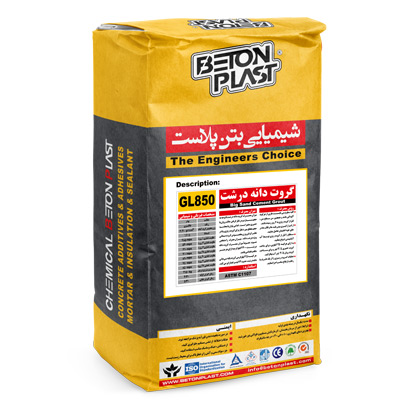
Nano big grout
Description
Nano big grout
Nano big grout, composed of aggregate (silica) up to 10 mm in size, concrete lubricant powder, polypropylene fibers and expanded materials (anti-contractilation) is formulated and produced which causes strong and resistant material and is used for grouting under base plates and grouting under the plate of heavy industrial machinery as well as grouting in large and bulky sections.

Features:
- Achieving compressive strength of 75 MPa
- Protection of rebars and reinforcements against corrosion
- Free expansion (volume change) controlled
Applications:
- Mounting and fixing anchor bolts and foundations of fences
- Possibility of installing and fixing the column plate of steel structure buildings
- Ability to fill the empty space between columns and foundations in low sections of armature and low volume
Technical specification table :
| state of | powder |
| Color | Gray |
| Special Weight | 3/2 gr/cm3 |
| Chlorine ion | does not have |
Package:
25kg bag
Product Description – Coarse-grained cement-based grout
The size, type, and shape of aggregates play a significant role in the strength of mortar, grout, or concrete. If we use inappropriate aggregates that have a high percentage of impurities and some very fine aggregates such as soil in the production of any mortar or concrete, it will certainly have a significant impact on the strength of the mortar and significantly reduce the compressive, flexural, and tensile strengths. In the case of grout, the type and size of aggregates are one of the most important elements in the quality and strength of the grout and the results related to the strength. Coarse-grained grout with controlled aggregate size is the most resistant cement-based grout among similar ones. In the formulation of coarse-grained cement-based grout, aggregates with a diameter of 5 to 10 mm are used, and the presence of this combination in the grout grading has increased the compressive and flexural strengths of coarse-grained cement-based grout compared to other similar cement-based grouts. The most prominent use of coarse-grained grout is for large-scale grouting where strength is of great importance. Due to the size and type of graining and the absence of very fine aggregates in the structure of this grout, adequate strength will be achieved after setting. One of the special advantages of this type of grout is grouting in sections with low reinforcement density. Coarse-grained cement grout is formulated and produced from cement, aggregate (silica) up to a nominal size of 10 mm, concrete softening powder, polypropylene fibers and expanding materials (anti-shrinkage), which forms a powerful and resistant mortar that is a very suitable option for grouting under base plates and grouting under the plate of heavy industrial machinery and grouting in large and bulky sections.
Coarse-grained cement grout is a ready-to-use dry mortar with a coarser grain size than other products in its group. Aggregate with a high percentage of impurities in the structure of mortar or concrete can have a significant impact on the strength of mortar or concrete and greatly reduce compressive and flexural strengths.
Column plate grout is used to fill gaps in concrete structures and other building structures. Coarse-grained cement grout can help increase the strength and stability of the surface. It is also suitable for industrial and construction applications that require high strength and heavy load bearing. Coarse-grained grout can also be used to prevent water leakage and increase resistance to water pressure. Using high-strength coarse-grained cement grout can help increase the durability and strength of structures and prevent repeated repairs.
Maintaining coarse-grained cement grout
What are the principles for storing high-strength coarse-grained grout powder?
Duration: One year in original packaging.
Conditions: Away from cold and frost, heat and direct and prolonged sunlight.
Best storage temperature: +10 to +30 degrees
Consumption of coarse-grained cement grout
What is the correct way to use coarse-grained cement grout?
The amount of coarse-grained grout used varies depending on the volume of the structure and whether it is liquid or paste-like. However, the amount of grout used can be determined by calculating the volume of the desired section for grouting and taking into account the specific gravity of the prepared coarse-grained special cement grout. Generally, the amount of coarse-grained grout used is 2400 kg per cubic meter of space. Each 25 kg bag of coarse-grained cement-based grout fills about 13 liters of space.
How to use coarse-grained cement grout
How to use coarse-grained cement grout?
- The distance between the bottom of the panels and the concrete surface must be at least 15 mm.
- Make sure the plates are in place and, if necessary, check the flatness of the base plates with a level.
- Note that grouting can be applied to surfaces that are at least 7 days old.
- The molds intended for grouting must be impervious to water leakage.
- All surfaces of sections that will be in contact with coarse-grained cement grout must be free of any contamination, grease, oil, dust, etc., to prevent water from escaping before initial setting.
- If there are weak spots or flaking on the concrete surfaces on which coarse-grained grout is applied, they should be removed from the surface by sandblasting, water jetting, or any other physical operation to achieve a durable and safe surface for grouting.
- The surface to be grouted should be irrigated with drinking water before grouting, so that the grout water is not absorbed by the dry surface after application and the mortar does not shrink or crack.
- The height of the molds intended for the application of coarse-grained cement grout should be considered 2 to 5 centimeters higher than the base plates.
- To prevent the formation of bubbles when pouring coarse-grained cement-based grout paste as a fluid, in large-volume grouting from the head box and in small-volume grouting from a 50-centimeter-wide sheet, the length of which is the same as the mold wall in the area to be poured, with a 45-degree slope, should be considered so that the grout fluid moves uniformly and continuously.
- Add the powder slowly while the electric mixer (drill + blade) is on and continue mixing until a homogeneous mixture is obtained.
- Choose a suitable container for mixing the ready-made coarse-grained grout powder with water, which has the capacity to mix one bag of coarse-grained grout and water.
- To make paste grout, 3.5 liters of water are required, and to produce flowable grout, 4.5 liters of water are required per 25 kg bag.
- If the cross-section is large, the fluid pressure can be increased by increasing the height.
- Be careful, always mix a quantity of coarse-grained cement grout powder with water that can be used within 30 minutes of mixing.
- Please note that adding any additives or cement and aggregate to the ready-made coarse-grained cement-based grout mixture is not permitted.
- Grouting operations should always be poured from one side and flow to other points under the weight and pressure of its fluidity. For better flowability, a metal rod or chain can be used as an aid.
- Be careful in hot and cold weather, coarse-grained cement grout powder should be kept in its original packaging and in a covered space. It is recommended to use cold water for mixing in hot weather conditions to balance the internal temperature of the cement-based grout, and to use hot water in cold weather conditions.
- For grouting very large sections, it is better to divide the desired section into smaller sections using temporary forms.
- Be careful to prevent excess air from being trapped by providing adequate space under the base plates.
- The ambient temperature during grouting should be between 5 and 30 degrees Celsius. Temperatures above 30 degrees will accelerate setting, and temperatures below 5 degrees will delay initial setting.
- Finally, after grouting and the grout has reached its initial setting, it is recommended to cover the mold and tools with a layer of wet burlap and to prevent the evaporation of water inside the grout, cover the surface of the burlap again with nylon. After grouting, surface curing should be done for 7 days.
Properties and effects of coarse-grained cement grout
What are the properties and effects of coarse-grained cement grout?
- Failure to achieve early initial and ultimate compressive strength
- Increasing the workability time of mortar in a paste state
- Achieving a compressive strength of 75 MPa
- Reduced permeability compared to normal mortars
- High tolerance against grout deformation, against applied forces, protection of rebars and reinforcements against corrosion
- Achieving high bending and tensile strengths
- High resistance to freeze-thaw cycles and temperature changes
- Achieving desired fluidity without the need to add superplasticizer
- Possibility of controlling mortar shrinkage due to the phenomenon of gas expansion
- No cracking due to shrinkage and shrinkage
- Possibility of faster operation of the structure
- Has controlled free expansion (volume change)
- Achieving early initial strength without the need to use setting accelerators
- Good resistance to weather changes
- No cracking after grout hardens
Application of coarse-grained cement grout
What are the uses of coarse-grained cement grout?
- Can be installed and fixed to anchor bolts and fence posts
- Suitable for installation of vibrating industrial machinery such as generators, turbines, compressors and diesel engines
- Filling the empty space between the column plate and the foundation in low reinforcement sections and with low volume
- Suitable for grouting bridge foundations and filling the empty space between the column and the bridge deck.
- Possibility of using as a ready-made, capable and resistant mortar for general construction work
- Installation and fixing of column plates of metal frame buildings
- Can be installed and fixed to prefabricated columns and walls
- Suitable for grouting around water pipes passing through concrete walls, as a waterproof mortar.
- Possibility of using coarse-grained cement grout instead of mortar or concrete
Coarse-grained cement grout packaging
How is coarse-grained cement grout packaged?
25 kg bag
Physical and chemical characteristics of coarse-grained cement grout
What are the physical and chemical characteristics of coarse-grained cement grout?
| Title | Feature |
| Mode | Powder |
| Color | Gray |
| Specific gravity | 3gr/cm |
| Standard | ASTM C476 – ASTM 942 |
| Chlorine ion | No |
| Compressive strength in the paste state | 1 day 26 MPa /
3 days 38 MPa / 28 days 64 MPa |
Mechanism of action of coarse-grained cement grout
What is the mechanism of action of coarse-grained grout?
Coarse-grained cement-based grout consists of cement, silica (aggregate) with a maximum aggregate size of 10 mm, powdered lubricant, polypropylene fibers and expanding materials, each of which in turn has effects on improving the properties of the grout mortar in the pasty and hardened state. The presence of aggregates, graded with a suitable size and shape, will enable the manufacture of a strong and integrated mortar, with controlled grain size and without the presence of fine particles at the level of soil. On the other hand, the presence of powdered lubricants reduces the need for grout powder to water to convert cement grout powder into paste or mortar, but at the same time it has its desired fluidity to flow under the base plates. Finally, in addition to increasing fluidity, it will increase compressive strength and other mechanical resistances. Polypropylene fibers also play an important role in the structure of coarse-grained cement grout by increasing abrasion resistance and improving some properties of concrete and will prevent cracking of the hardened mortar. On the other hand, the presence of special expanding materials, or shrinkage-compensating materials in the coarse-grained grout formulation, compensates for one of the most important weaknesses of ordinary mortars, namely shrinkage and cracking due to evaporation of mortar water. Expanding materials create controlled expansion in the coarse-grained grout mortar to resist shrinkage.
Safety of coarse-grained cement grout
What are the safety conditions when using coarse-grained cement grout?
- Coarse-grained cement grout is not a toxic, flammable, or environmentally hazardous material.
- In case of accidental contact with skin or eyes, wash with fresh water.
- If swallowed, seek medical attention immediately.
- Avoid direct breathing when mixing grout.
Standard coarse-grained cement grout
According to which standards is coarse-grained cement grout produced?
ASTM C476 – ASTM 942 standard
Price of coarse-grained cement grout
Beton Plast Company, as one of the reputable manufacturers in the field of coarse-grained cement grout, offers quality products to the market. With years of experience in the construction industry, this company has been able to gain the trust of customers and offer its products at competitive prices.
For more information on the price and features of coarse-grained cement grout, you can visit the Beton Plast website or contact the company’s sales experts. They will be happy to help you choose the best product for your project.
By considering these points, you can make a better decision about purchasing coarse-grained cement grout and benefit from the high quality of Beton Plast products.
Price of coarse-grained cement grout
Coarse-grained cement grout is a widely used construction material that is used in various projects due to its special properties. The price of this type of grout is affected by several factors, which are mentioned below.
Factors affecting the price of coarse-grained cement grout
Quality of raw materials: The type and quality of cement, aggregates, and other additives can have a big impact on the final price of the grout. Higher quality grouts usually cost more.
Strength and technical properties: Grouts with special strengths and no shrinkage usually have a higher price. These properties allow the grout to be used in special situations such as under the surface of columns and in sensitive projects.
Purchase volume: Bulk purchases usually come with greater discounts. Therefore, purchase volume can affect the price.
Manufacturer: Reputable brands usually have higher prices, but offer better quality and after-sales service.
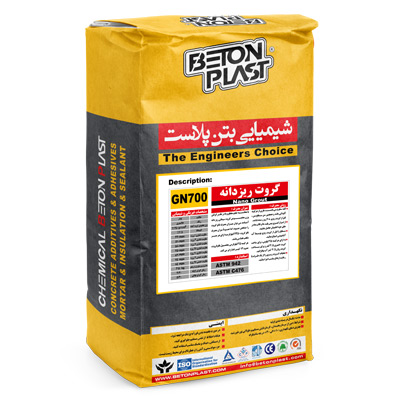


Reviews
There are no reviews yet.