
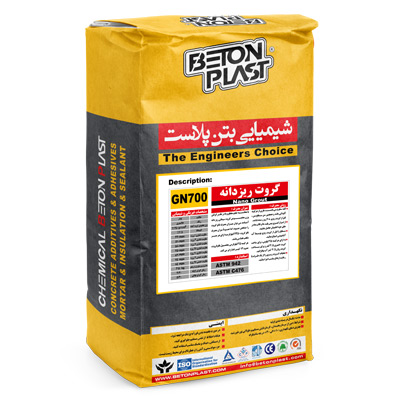
Nano tiny grout
Description
Nano tiny grout
nano grout is composed of cement, aggregates up to 1 mm in diameter, powder lubricant, polypropylene fibers and expander materials and is formulated. This product is suitable for filling void space under base plates, implementation of foundations of heavy machinery, as well as steel substrates and fixing prefabricated columns.
Features:
- No cracking after hardening
- Acquisition of initial and final high resistance in the early ages of Grout
- Contained, controllable expansion
Applications:
- Ability to implement the foundations of heavy machinery and install and fix them
- Ability to fill the space under transmission rails in industrial factories
- Grouting the location of bolts and concrete boxes
Technical specification table :
| state of | powder |
| Color | Gray |
| Special Weight | 3/2 gr/cm3 |
| Chlorine ion | does not have |
Package:
25kg bag
Product Description – Fine-Grained Grout (Nano Grout)
There are many concrete sections that, due to specific conditions and structural calculations, have a very high reinforcement density, and in some places this density is so high that it does not allow the mortar aggregates to pass through. In addition, vibrating these high-density sections is also very difficult. For this reason, grouting sections with high rebar density is always a major concern for respected contractors. In sections with high reinforcement density, the size of the aggregates in normal cement-based grouts may prevent the grout mixture from flowing uniformly and homogeneously to all points of the desired section, and in some high-density points, the aggregates may get stuck, and finally the concrete mixture may encounter weak aggregates in some points. In order to solve this problem, the mortar must be formulated and produced with appropriate grain size, so that it can easily pass through the rebar density and at the same time have a good flow and do not require vibration. For this reason, using fine-grained cement-based grout is a good option, and due to the granularity of the aggregates up to one millimeter, they easily pass through the high-density points of the rebar. Fine-grained cement grouts are a type of ready-made, high-strength, non-compaction fine-grained mortar that is modeled and produced based on cement, granular aggregates, polypropylene fibers, powdered lubricants, and expanding materials. Nano-grout, due to its unique structure and granularity of its constituent components, is very suitable for filling the empty space under base plates, implementing foundations for heavy machinery and steel substructures, and fixing prefabricated columns. One of the special characteristics of fine-grained grout or nano-grout is that, due to its fine and desirable granularity, it flows easily in concrete sections and there is no need to apply vibration to compact and consolidate the mortar.
Fine-grained grout or nano-grout has high strength and is completely free of controlled shrinkage and expansion. Also, due to the fine grain size that is present in the formulation of fine-grained grout, it is considered a very good option for grout injection for reinforcement. Because it is fine-grained, it flows easily and does not require vibration. Nano-grout is more suitable for grouting in high-density areas due to its finer grain size than other cement-based grouts, and it also has greater fluidity and fluidity.
Maintaining fine-grained grout (nano grout)
What are the principles of maintaining fine-grained cement nano grout?
Duration: One year in original packaging.
Conditions: Away from cold and frost, heat and direct and prolonged sunlight.
Best storage temperature: +10 to +30 degrees
Consumption of fine-grained grout (nano grout)
What is the amount of fine-grained grout used?
By calculating the cross-sectional volume and taking into account the specific gravity of the prepared fine-grained cement grout, the amount of nano grout consumption can be determined, but generally the amount of grout consumption is 2350 kilograms per cubic meter of space. Each 25-kilogram bag of nano grout fills about 13 liters of space.
Packaging of fine-grained grout (nano grout)
What is the packaging of fine-grained cement nano grout?
25 kg bag
How to use fine-grained grout (nano grout)
What is the correct way to use nano grout?
- The distance between the bottom of the plates and the concrete surface must be at least one centimeter.
- Make sure the plates are in place and, if necessary, check the flatness of the base plates with a level.
- Make sure that the cement or concrete surface on which the grout is applied must be at least 7 days old.
- The molds intended for grouting must be resistant to permeability.
- All surfaces of sections that will be in contact with fine-grained grout must be free of any contamination, grease, oil, dust, etc.
- If there are loose or flaky spots on the concrete surface where fine-grained grout is applied, remove them using a submersible or water jet, or any other physical operation, to achieve a safe and durable surface for application.
- To prevent bubbles from forming when pouring fine-grained cement grout paste, it should be considered as a fluid in large-volume grouting from the head box and in small-volume grouting from a 50-centimeter-wide sheet, the length of which is the same as the mold wall in the desired area for pouring with a 45-degree slope, so that the nano-grout fluid moves uniformly and continuously.
- The height of the molds intended for grouting should be 2 to 5 centimeters higher than the base plates.
- To make paste grout, 3.5 liters of water are required, and to produce flowable grout, 4.5 liters of water are required per 25 kg bag.
- The surface to be grouted must be saturated with drinking water before applying fine-grained grout so that the grout water is not absorbed by the dry surface and cracks after application.
- Choose a suitable container for mixing ready-made fine-grained cement grout powder with water that has the capacity to mix one bag of nano grout with water.
- Please note that adding any additives or cement and aggregate to the prepared fine-grained grout mixture is not permitted.
- Slowly add the powder to the water while the electric mixer (drill + blade) is on and continue mixing until a homogeneous mixture is obtained.
- Note that you should always mix a small amount of fine-grained cement-based grout powder with water and use it within 30 minutes of mixing.
- Note that excess air can be prevented from being trapped by providing adequate clearance under the base plates.
- Grouting should always be done from one side and flow to other points under its own weight and fluid pressure. For better flowability, a metal rod or chain can be used as an aid. If the cross-section is large, the fluid pressure can be increased by increasing the height.
- For grouting very large sections, it is better to divide the desired section into smaller sections using temporary forms.
- After grouting is complete and the grout has reached its initial setting, it is recommended to cover the mold and tools with a layer of wet burlap and to prevent the evaporation of water inside the grout, cover the surface of the burlap again with nylon. After grouting, surface curing should be done for 7 days.
- The ambient temperature during grouting should be between 5 and 30 degrees Celsius. Temperatures above 30 degrees will accelerate setting, and temperatures below 5 degrees will delay the initial setting of the cement nano-grout.
- Note that in hot or cold weather, fine-grained cement grout powder should be kept in its original packaging and in a covered space. It is recommended to use cold water for mixing in hot weather conditions to balance the internal temperature of the nano grout, and to use hot water for mixing in cold weather conditions.
Properties and effects of fine-grained grout (nano-grout)
What are the properties and effects of fine-grained grout?
- No compaction or shrinkage during and after the setting process
- High resistance to high static loads
- No cracking after hardening
- Possibility of creating controlled expansions
- Achieving optimal fluidity without the need to add superplasticizer
- The need for a minimum amount of water for mixing due to the presence of superplasticizers in the formulation for producing fine-grained grout.
- Ease of use in sections with high reinforcement density, due to favorable flow and finer grain size
- High hardening speed after application
- Obtaining high initial and final strength at early grout ages
- Has a controlled free expansion rate
- Greater reduction in permeability compared to other similar cement grouts due to the lack of filler and fine grains
- Has controlled and controllable expansion
- Ability to load early and operate the structure faster
- Achieving desired fluidity without causing water loss or separation
Application of fine-grained grout (nano-grout)
What are the uses of fine-grained grout?
- Steel foundations and fixing prefabricated columns
- Suitable for filling empty space under base plates or column plates
- Implementing heavy machinery foundations and installing and fixing them
- Suitable for implementing resistant concrete under foundations
- Filling and planting the space around reinforcements and anchor bolts
- Can be used to fill the space under conveyor rails in industrial factories
- Ability to fill the empty space between the bridge base and deck
- Suitable for construction and repair work inside apartments and houses as a ready-made mortar with high resistance.
- Suitable for installing and securing prefabricated columns and walls
- Grouting the location of bolts and concrete boxes
- Can be used to fill empty spaces between two concretes that require resistant concrete.
- Suitable for use as new concrete for application over old concrete
- Ability to fill holes, gaps and potholes
- Suitable for use as repair mortar in deep sections
Table of physical and chemical properties of fine-grained grout (nano-grout)
What are the physical and chemical properties of fine-grained grout?
| Title | Feature |
| Mode | Powder |
| Color | Gray |
| Specific gravity | 3/2g/cm3 |
| Standard | ASTM C476 – ASTM 942 |
| Chlorine ion | No |
Mechanism of action of fine-grained grout (nano-grout)
What is the mechanism of action of fine-grained grout?
Fine-grained cement-based grout or nano-grout consists of cement, aggregates graded up to 1 mm in diameter, powdered lubricant, polypropylene fibers, and expanding materials, each of which has its own effects on improving the properties of the mortar in the pasty or hardened state. The presence of fine-grained aggregates will enable nano-grout to make a strong mortar with controlled grain size (without soil). Nano-grout, due to its fine grain size (maximum diameter of 1 mm), has the ability to flow and spread more easily than conventional grouts, in high-density and low-volume sections. On the other hand, the presence of powdered lubricants in the formulation of fine-grained grout reduces the need for water for the grout powder to turn into paste and mortar. Finally, in addition to increasing fluidity and improving flowability and self-compacting properties, it will also increase the compressive strength and other mechanical strengths of fine-grained grout mortar. The polypropylene fibers in the nano grout structure also play an important role in the structure of fine-grained cement-based grout by increasing abrasion resistance and improving some mechanical properties. The special expanding materials, or shrinkage-compensating materials in the grout, compensate for one of the most important weaknesses in conventional mortars, which is the formation of cracks and shrinkage due to water loss, and achieve controlled free expansion for the grout.
Safety of fine-grained grout (nano-grout)
What are the safety conditions when using fine-grained grout?
- Fine-grained cement grout is not a toxic or environmentally hazardous material.
- This substance should never be swallowed.
- This substance should never come into contact with the eyes.
- In case of contact with skin or eyes, wash immediately with fresh water.
- Avoid direct breathing when mixing grout.
Fine-grained grout standard (nano grout)
Which global standards are used to measure fine-grained grout?
ASTM C476-ASTM 942 standard
Fine-grained grout price (nano grout)
Purchase and price of fine-grained ready-made grout
The price of fine-grained ready-mixed grout at Beton Plast Company is very competitive and fair, because we, as the main manufacturer of this product, offer quality and reasonable price. We recommend you to buy this type of grout, because it has high compressive strength, which is very suitable for various projects.
Before placing an order, you can contact Beton Plast’s specialized sales team and benefit from our free consultation. This product is ready to be supplied to customers in 25 kg packages.
Properties and characteristics of fine-grained ready-mixed grout
Fine-grained ready-mixed grout is one of our best-selling products at Beton Cover, and the amount of use depends on the type of project you have. If needed, you can use our experts’ free consultation.
The features of this grout include the following:
High compressive, tensile, and bending strength: These features increase the durability and strength of the structure.
Ease of use and quick setting: This reduces project implementation time.
Reduced setup and installation costs: Using this product reduces overall project costs.
High fluidity and durability: These features help prevent cracking and shrinkage.
Resistance to impact and dynamic loads: This grout is well resistant to various pressures.


Reviews
There are no reviews yet.