
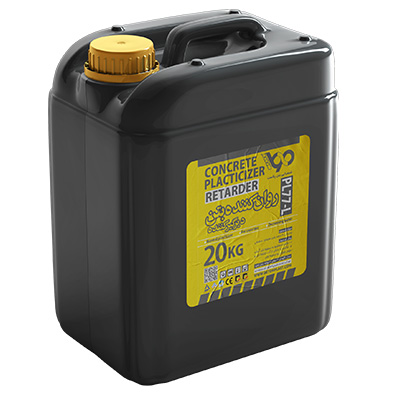
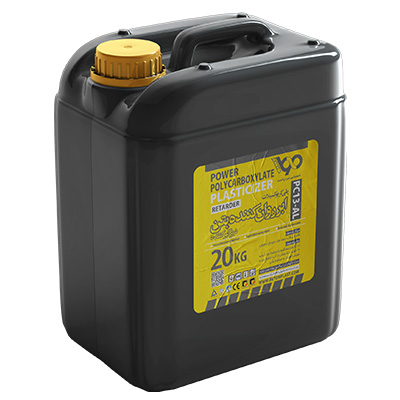
Power polycarboxylate plasticizer-retarder
Description
Power polycarboxylate plasticizer-retarder
Late Concrete Superplasticizer, based on Polycarboxylate Ether, is formulated from one main branch and several sub-branches. Concrete superplasticizer is a very strong reducer of concrete mixing water and is a very strong increase in the performance of high-performance concrete and dramatically expands the dispersion of cement particles into the mixture.
Features:
- Creates good looking concrete or exposis
- Increases density and reduces permeability of concrete
- Reduces shrinkage and creep of concrete
Applications:
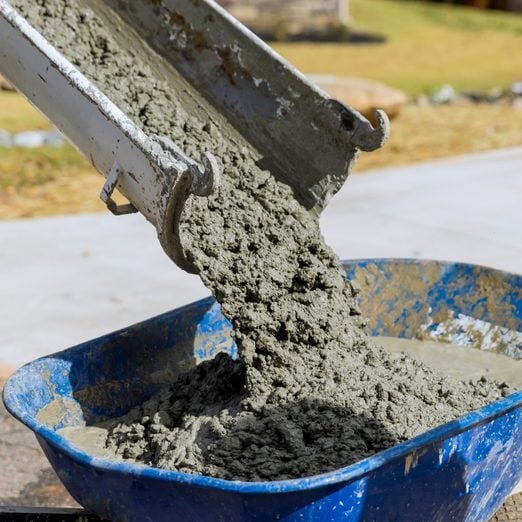
- Ability to produce injection concrete
- It is suitable for bulky concretes
- Possibility to run pumpable concrete
Technical specification table:
| Appearance | liquid |
| Color | brown |
| Specific gravity | gr/cm3 1/13 |
| standard | ASTM C494 – ASTM C1017 |
| ph | 7 |
Package:
20 litter galon
Product Description – Delayed setting concrete lubricant
Delayed-setting concrete lubricant, a liquid admixture based on lignosulfonate and a modeled concrete setting retarder that can be used to increase the fluidity and workability of concrete and reduce the water-to-cement ratio in concrete mix design. In addition to the properties mentioned, control of concrete setting at early ages will also be available. The use of this lubricant is recommended in high-volume concreting and also in hot weather conditions. Also, in situations where the distance between the concrete production site and the concreting site is long, by adding this delayed-setting lubricant at the beginning, its setting and slump can be controlled. Regarding the use of delayed-setting cement lubricant based on lignosulfonate, note that the increase in strength at early ages of concrete is relatively small, but we will see a desirable increase in strength at 90 days of age. Also, the use of this lubricant has the ability to reduce concrete water by up to 10%.
Concrete admixtures are chemical additives that improve the flowability of concrete and help reduce the amount of water in concrete. These delayed-setting concrete admixtures increase the strength and durability of concrete without compromising its workability, and they provide good workability in all climates and are also highly resistant to frost. Used during the concreting of columns and walls, especially in warm or tropical climates, this admixture prevents the concrete from setting too quickly and allows for better workability and placement. Ultimately, if you are working with concrete, using the right admixture can make a significant difference.
Packaging of delayed-setting concrete lubricant
What is the packaging of delayed-setting concrete lubricant?
20 liter gallon
220 liter barrel
1000 liter tank
Consumption rate of slow-setting concrete lubricant
What is the dosage of slow-setting concrete lubricant?
The exact amount of the delayed-setting concrete lubricant additive is determined by conducting proper site tests, weather conditions, and the type of materials used. The best consumption range for this lubricant is between 1.5 and 2 percent of the weight of cement used in concrete. Excessive consumption of this lubricant is not permitted, and it is recommended to consult with experts from Beton Plast Chemical Company if necessary. Excessive consumption leads to excessive slowness in setting and weakens the hydration process.
Maintenance of delayed-setting concrete lubricant
What is the proper maintenance method for delayed-setting concrete lubricant?
Principles of maintenance of delayed-setting concrete lubricant
Duration: One year in original packaging.
Conditions: Away from cold and frost, heat and direct and prolonged sunlight.
Best storage temperature: +10 to +30 degrees
How to use slow-setting concrete lubricant
How is delayed-setting concrete lubricant used?
- This plasticizer can be added to the ready-mixed concrete and after complete mixing, concrete can be placed. It is recommended to mix for at least 1 minute per cubic meter of concrete.
- The amount of slow-setting concrete lubricant calculated according to the grade of concrete should be diluted with 2 times the volume of concrete mixing water. The diluted admixture should be added gradually to the concrete during mixing.
- Delayed-setting concrete lubricant can be added to the batching or truck mixer during concrete production.
Note: It should be noted that the lubricating additive should not be poured directly onto dry cement.
Properties and effects of delayed-setting concrete lubricants
What properties and effects does delayed-setting concrete lubricant have on concrete?
- Increasing slump and fluidity of concrete
- Increasing the workability time of concrete
- Increasing the adhesion of materials in concrete with improper grain size
- Concrete water reduction of about 10 percent
- Increasing the compressive and flexural strength of concrete
- Preventing aggregate separation and concrete water loss
- Control during initial setting of concrete
- Preventing cold joints in concrete
- Preventing shrinkage and shrinkage of concrete
- Increasing the durability and reliability of concrete
- Preventing surface cracks in concrete
- Preventing concrete creep
- Suitable for large-scale concreting
Applications of delayed setting concrete lubricants
What are the practical uses of delayed-setting concrete lubricants?
- Implementation of prestressed and post-stressed concrete
- Placing concrete in hot weather conditions
- Ability to implement projects that require water reduction to reduce permeability.
- Ability to pour concrete in places where the density of reinforcement is high.
- Producing and transporting concrete over long distances
- Suitable for producing bricks and concrete blocks
- Suitable for the execution and concreting of all structural elements.
- Suitable for producing pumpable concrete.
- Ability to produce concrete using crushed stone materials
Physical and chemical characteristics of delayed-setting concrete lubricant
Physical and chemical characteristics of delayed-setting concrete lubricant
What are the physical and chemical properties of delayed-setting concrete lubricant?
| Title | Feature |
| Mode | Liquid |
| Color | Brown |
| Specific gravity | 12/1gr/cm3 |
| Standard | ASTM C494 |
| Chlorine ion | No |
| PH | About 7 |
Mechanism of action of delayed setting concrete lubricant
What is the mechanism of action of delayed-release concrete lubricant in improving concrete quality?
When adding a lignosulfonate-based retarding concrete lubricant to water and cement, the polar anionic group in the molecules is attached to a hydrocarbon chain that is also polar and has several OH groups. By adding this lubricant to the mixture, the polar head of the lignosulfonate-based retarding concrete lubricant molecule bonds to the cement particles and, due to the polarization of the particles, prevents them from agglomerating, thus increasing the fluidity of the concrete mixture and causing better dispersion of the constituent particles in the mixing design. In addition to the fluidity properties, the formulation of the lignosulfonate-based retarding concrete lubricant uses materials that, after contact with cement, will cause a slowdown in setting and speed up the hydration process, thus increasing the workability time of the concrete.
How to recognize a good quality long-lasting lubricant?
A good quality retarding lubricant should have a good density. The best criterion for testing a retarding lubricant is its optimal performance according to the consumption rate recommended by the manufacturer. Of course, it should be noted that this consumption rate is also within the normal range and does not exceed the permissible limit. If a retarding concrete lubricant product with low concentration and quality is used, we will be forced to use a larger amount of the lubricant in the concrete, which will lead to a decrease in strength due to the introduction of more water than the permissible limit into the mixture. There should also be a controlled retarding rate for the retarding lubricant. For example, if the retarding rate exceeds the permissible limit, the hydration process will be delayed more than the permissible limit or will not take place at all.
Important safety issues regarding delayed-setting concrete lubricants
What are the proper safety conditions when using delayed-release concrete lubricant?
- This material is not toxic, dangerous, or flammable.
- Concrete softener should never come into contact with the eyes. If it does come into contact with the eyes, rinse immediately with plenty of water.
- If skin sensitivity occurs, see a doctor.
- Wear appropriate glasses, gloves, and a mask when using.
Standard for delayed setting concrete lubricants
According to which global standard is delayed-setting concrete lubricant produced?
ASTM C494


Reviews
There are no reviews yet.