

microsilica gel-retrader
Description
microsilica gel-retrader
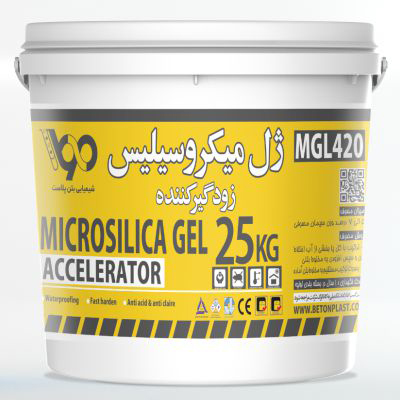
microsilica gel-retrader is a widely used product based on carboxylated lubricants, silica soot, fillers and concrete retardant additives. This product reduces the permeability of hardened concrete by compacting the concrete mass and filling the gaps between aggregates.
Features:
- Reduce the amount of cement consumed by about 10 to 15 percent reduction in the ratio of water to cement
- Increased concrete working time
- Increased abrasion resistance of concrete
Applications:
- Suitable for concreting in warm climates and tropical regions
- Suitable for bulky concrete pouring
- Concrete pouring in areas under destructive chemical ions
Technical specification table:
| Color | Dark Grey |
| Specific Gravity | Gr/cm3 1/35-1/30 |
| Standard | ASTMC-494TYPEF
BS EN12390 BS1888 – 122 – 8 |
| PH | 8 |
| Chlorine ion | Doesn’t have |
Package:
25 Kg Bucket
Product Description – Slow-release microsilica gel
Delayed setting microsilica gel is a very powerful product formulated and produced based on carboxylate lubricants, silica fume, fillers and concrete retarding additives. Delayed setting microsilica gel is added to concrete during construction to make powerful and multi-purpose concretes and develops the rheological properties of concrete in the paste state and improves the properties of hardened concrete. By increasing the slump of concrete due to the presence of a powerful lubricant based on polycarboxylate ether, this material reduces a significant amount of water in the concrete and ultimately increases the compressive strength of concrete. Delayed setting microsilica gel will reduce the permeability of hardened concrete by densifying the concrete mass and also filling the empty spaces between the aggregates. Also, retarding materials are present in the delayed setting concrete supplement formulation, which delays the setting time and also slows down the progress of the hydration reaction. Retardant microsilica gel is suitable for concreting in hot climates and tropical regions.
Retarding silica gel is a functional product that is added to concrete and is considered one of the most important additives in the concrete manufacturing industry. Retarding silica gel reduces the permeability of concrete as much as possible. It is also classified based on the setting of concrete and is divided into three categories: retarding gel, fast-setting gel, and normal gel. Each of these products is very useful in its own specific weather conditions.
How to use slow-release silica gel
Delayed setting silica gel can be added to concrete in two ways:
- Delayed setting silica gel can be added to the mix design after all concrete mix components have been added.
- Mix this material with mud or part of the concrete mixing water, then add to the dry materials and mix.
Note: Using more than the permitted amount of delayed-setting microsilica gel additive can increase the rate of delayed-setting of concrete and disrupt the setting of concrete.
Note: It should be noted that at least 1 minute of mixing operation must be performed for each cubic meter of concrete.
How much to use for slow release silica gel
The amount of this type of microsilica gel used is determined by conducting detailed laboratory studies and depends on the weather conditions and the types of materials used. Typically, the amount of slow-setting microsilica gel used is 5 to 7 percent of the weight of the cement used. Note that to achieve high compressive strength and achieve strong concrete, you should reduce the mixing water by 10 to 15 percent before adding the slow-setting microsilica gel . The amount of this product added changes the slow-setting time depending on the weather conditions.
Delayed release silica gel packaging
25 kg bucket
Long-lasting silica gel storage
Duration: One year in original packaging.
Conditions: Away from cold and frost, heat and direct and prolonged sunlight.
Best storage temperature: +10 to +30 degrees
Properties and effects of slow-release silica gel
- Increasing fluidity with concrete efficiency
- Increasing the strength and durability of concrete
- Reducing the amount of cement consumed by about 10 to 15 percent
- Reducing the water-to-cement ratio
- Delaying the setting time of concrete
- Increasing the abrasion resistance of concrete
- Increasing the workability time of concrete
- Preventing the formation of surface cracks caused by thermal stresses
Applications of delayed release silica gel
- Capable of making high-strength and durable concrete
- Suitable for making and transporting concrete over long distances.
- Suitable for concreting in hot climates and tropical regions
- Concrete construction of structures exposed to freeze-thaw cycles
- Suitable for making concrete structures exposed to abrasion
- Ability to implement impermeable concrete
- Concrete construction of water structures such as canals, pools, reservoirs, etc.
- Concreting in areas subject to chemical corrosive ions
- Suitable for large-scale concreting
- Making concrete for the construction of dams, tunnels, bridges, etc.
Physical and chemical properties of slow-release silica gel
What are the physical and chemical properties of slow-release silica gel?
| Title | Feature |
| Mode | Thick slurry |
| Color | Dark gray |
| Specific gravity | 1/30gr / cm3 to 1/35 |
| Chlorine ion | No |
| PH | About 8 |
Mechanism of action of delayed release silica gel
Mechanism of action of silica fume in the formulation of delayed-setting microsilica gel is a powerful pozzolanic material that can be a suitable substitute for cement and has a function similar to cement. After mixing with water and calcium hydroxide, silica fume reacts and thus produces hard calcium silicate, which has a great effect on hardening concrete and increasing its strength. In addition, the polycarboxylate ether in the formulation of delayed-setting microsilica gel, which plays the role of a lubricant, forms a membrane on the cement particles and prevents the cement particles from accumulating together by creating a spatial barrier due to the thickness of the absorbed layer. It creates a repulsive force between the particles due to the absorption of polymer particles by creating homonymous charges, thus lubricating the concrete. The polypropylene fibers in the structure of delayed-setting microsilica gel will also, in turn, develop the mechanical and abrasion properties of concrete. In addition, the setting retarders present in the formulation of this material make it possible to control the setting time.
Safety of delayed release silica gel
- This material is not toxic or hazardous to the environment.
- If swallowed, seek medical attention immediately.
- In case of accidental contact with skin or eyes, rinse immediately with plenty of fresh water.
- Wear a mask, gloves, and safety glasses when working with any chemicals.
Standard slow-release silica gel
Standard ASTMC – 494TYPEF – BS1881 – 122 – 8 – EN12390



Reviews
There are no reviews yet.