

Double fix spacer
Description
Double fix spacer
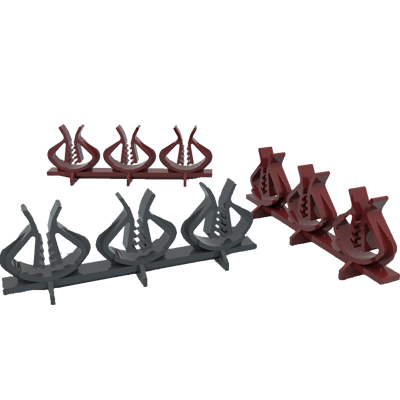
Double-fix spacers are made of two parts of the base and head and are assembled inside each other. The base part of the plastic spacer double-fix for the placement of the bottom row mesh of the slab and the head part is also special for the placement of the top row mesh in the slab. They are used for the use of concrete reinforcement.

Applications:
- Capable of bearing spot load from 150 to 200 kg
- The maximum size of rebar is 28 mm for placing on the base
- Double Fix plastic cover head is able to accommodate rebar up to 18mm diameter
- Differing between two wings of the spacer base and the ability of rebars to be cut on each other
packing :
| Name | Size | Bar size | Packing (QTY) | WEIGHT (KG) |
| Down 25/40 | 25/40 | ≥ 32 | 200 | 7/6 |
| 90 Up | 90 | 10 – 22 | 400 | 9/6 |
| 100 Up | 100 | 10 – 22 | 400 | 10 |
| 110 Up | 110 | 10 – 22 | 400 | 10/8 |
| 120 Up | 120 | 10 – 22 | 400 | 12/1 |
| 130 Up | 130 | 10 – 22 | 400 | 13/3 |
| 140 Up | 140 | 10 – 22 | 400 | 16/9 |
| 150 Up | 150 | 10 – 22 | 200 | 11 |
| 180 Up | 180 | 10 – 22 | 300 | 8/5 |
Product Description – Double Fix Spacer
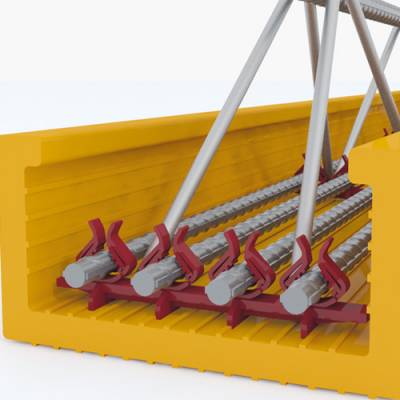
In many cases, concrete structures are constructed as concrete slabs (all-concrete), which require the placement of two grids or two rows of rebar to reinforce the concrete. If we want to use plastic spacers separately for the lower and upper row spacers, it is not economically viable, and on the other hand, in many sections of the lower rebar grids, the spacers used will interfere with the upper mesh. For this reason, a special double-fix plastic spacer has been modeled and produced. This spacer is made of two parts, a base and a head, and they are assembled into a drawer inside each other. The base part of the double-fix plastic spacer is designed for placing the meshes of the lower row of the slab, and the head part is designed for placing the meshes of the upper row in the concrete slab. The base part, due to its sufficient width, accepts the placement of free-sized rebar, but considering the load-bearing capacity of the plastic spacer for the two meshes, a maximum of 28 mm rebar is recommended for placement on the base. The double-fix plastic head cover section is also capable of accommodating rebar up to a maximum diameter of 18 mm. The double-fix plastic double-mesh spacer has a point load bearing capacity of 150 to 200 kg, which will vary based on the height of the spacer.
In fact, this product is known for its ability to adjust the horizontal distance between the reinforcement grids in concrete structures. In general, the main function of the manufactured part is to maintain the horizontal distance between the two reinforcement grids. It is also considered a feature that allows this spacer to adjust and maintain the distance with high precision.
This Double Fix Spacer is one of the types of spacers used to maintain and maintain rebars in reinforced concrete structures. This type of piece is designed and presented to provide the appropriate distance between the rebars and the concrete formwork and to create a uniform concrete coating. The presented piece fixes the rebars in two different directions, which is able to help maintain the exact position of the rebars. Due to its features, this plastic spacer can help improve the quality and durability of concrete structures and is also able to prevent common problems in these types of structures.
Consumption of Double Fix plastic spacer
What is the dosage of Double Fix spacer?
Double-grid slabs with normal weight:
The standard usage rate of Double Fix spacers is 4 per square meter.
Heavy weight double grid slabs:
By calculating the weight of the reinforcing mesh per square meter, as well as the dead and live loads, and considering the load-bearing capacity of the double-fix plastic spacer, the required number of plastic spacers for two meshes per square meter is determined. Note that if the reinforcement mesh is too heavy, use a hard-fix spacer with a distance of 1 to 2 meters from each other for the lower meshes to reduce the pressure on the double-fix spacer.
How to use Double Fix plastic spacer
How to use the Double Fix plastic spacer?
First, place the male or head in the groove of the double-fix base and press it all the way in. Then, place the lower mesh bars on the base. It is important to note that the height of the two wings of the double-fix spacer base is different from the other two wings, allowing the bars to be placed crosswise. After weaving and arranging the bottom row of bars, the upper mesh bars should be placed inside the working prongs of the double-fix spacer head.
Learn more; Wheel Fix Spacer
Important points about Double Fix plastic spacers
What are the important points when using the Double Fix spacer?
- Double Fix double grid spacer is specifically designed for use in concrete slab ceilings or relatively thick concrete floors that are reinforced with two rows of rebar.
- If, in certain circumstances, the weight of the lower rebar network is heavier than normal, a single Double Fix base can be used as an auxiliary support. Of course, this can also be done using other spacers, such as Hard Fixes. Keep in mind that if the upper rebar network is heavy, Hard Fixes can be used as reinforcement at regular intervals, between Double Fix spacers.
- Typically, 4 double-fix spacers are used per square meter, but considering the weight of one square meter of the rebar structure and the dead and live loads applied, and considering the point load capacity of the double-fix spacer, the appropriate number for each square meter can be obtained.
- If, after calculating the weight of one square meter of the rebar structure, a lower weight is calculated for the structure, considering the dead and live loads, the distances can be increased. Conversely, when the weight of one square meter of the steel structure, taking into account other forces applied during the project implementation, exceeds the bearing capacity of 4 double-fixed spacers (in normal mode) per square meter, the number of spacers used can be increased.


Reviews
There are no reviews yet.