
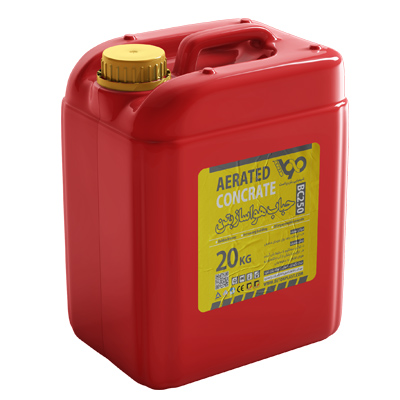
Aerated Concrete
AHSDGFDJHAVDHGSAVFCNSBAVCSNAMBVCSANMBVCSAVFBCANMVCFSNABMFVN
Description
Description: Aerated Concrete
Aerated concrete additive is a material for forming regular spherical and uniform micronized air bubbles in concrete, which is chained in concrete mixture and increases the durability and stability of concrete against degradation caused by freezing and special melt salts.

Features:
- Water reduction of concrete mixing without cracking concrete performance
- Increasing the durability and stability of concrete in cold weather conditions
Applications:
- Suitable for running concrete floors and concrete surfaces exposed to open air
- Construction and implementation of concrete refrigeration
Technical specification table:
| Appearance | liquid |
| Color | Brown |
| Specific gravity | 1/03 gr/cm3 |
| Standard | ASTM C260 ASTM C666 ASTM C233 |
| PH | 8 |
| Dissolution capability |
In water |
| Chlorine ion | Doesn’t have |
Package:
20kg gallon
Product Description – Concrete Air Entraining Bubble
Concrete air entraining admixture is a material for forming regular spherical and uniform micronized air bubbles in concrete, which are distributed in a chain form in the concrete mixture and increase the durability and resistance of concrete against damage caused by freezing and special melting salts. It is added to the concrete mixture in order to reduce permeability and increase the life of concrete against repeated cycles of melting and freezing. Of course, in cases where the concrete mixture has a suitable granulation, the use of this product between the aggregates significantly reduces the water loss of the mixture. Also, the use of this product causes the air bubbles created in the concrete to be preserved and stable.
Small air pockets play an important role in improving the properties and durability of concrete. Fresh concrete also contains many air bubbles that are formed during the mixing process and this chemical concrete admixture . A small number of bubbles are also created from air dissolved in water. This product acts as a pressure relief tank in hardened concrete and also helps with frost resistance.
Concrete air bubble packaging
20 liter gallon
220 liter barrel
1000 liter tank
Amount of air-entraining agent used in concrete
Considering the amount of air that concrete air entrainment creates in the range of 4 to 6 percent in concrete, and various conditions such as cement type, water to cement ratio, aggregate type, alkalinity level, ambient temperature, and concrete temperature have a significant effect on the amount of air entrainment, it is recommended to conduct detailed workshop tests to obtain the exact amount of consumption. However, the amount of concrete air entrainment used is usually 0.2 to 0.5 percent of the weight of the cement used.
Concrete air bubble maintenance
Duration: One year in original packaging
Conditions: Away from cold and frost, heat and direct and prolonged sunlight.
Best storage temperature: +10 to +30 degrees
How to use air-entraining bubbles in concrete
1- The amount of air-entraining admixture calculated according to the grade of concrete should be diluted with 2 times the volume of concrete mixing water. The diluted admixture should be added gradually to the concrete during mixing.
2- This product can be added to the ready-mixed concrete and after complete mixing, concreting can be carried out.
Note: It is recommended to mix for at least 1 minute per cubic meter of concrete.
Note: It should be noted that the concrete air-entraining admixture should not be poured directly onto dry cement.
The best time to add air-entraining admixture to concrete is 5 minutes after the concrete components are completely mixed.
Properties and effects of air-entraining bubbles in concrete
- Reducing concrete permeability
- Increasing the durability and reliability of concrete in cold environmental conditions
- Increasing the durability of concrete against repeated cycles of melting and freezing
- Maintaining and stabilizing air bubbles created in concrete
- Increasing concrete performance, especially in concretes that are poor in fine grains
- Reduced water loss and aggregate separation due to increased adhesion and greater consistency of concrete
- Reducing concrete mixing water without compromising concrete workability. Reducing concrete surface peeling due to the production of tiny air bubbles.
- Reduced continuity of capillary tubes in concrete due to disruption of their path due to the creation of air bubbles
Applications of concrete air entraining bubbles
- Concreting in cold areas
- Ideal for producing concrete New Jersey
- Making concrete tables and floors
- Construction and implementation of cold storage concrete
- Airport runways, concrete roads, bridge decks
- Suitable for use in concrete containing cement with high lime content.
- Suitable for concrete floors and surfaces exposed to the open air
- All large concrete surfaces exposed to frost. Ideal concrete construction for dams, reservoirs, and irrigation and drainage networks.
Table of physical and chemical characteristics of concrete air-entraining bubbles
| Title | Feature |
| Mode | Liquid |
| Color | Light honey |
| Specific gravity | 1/03g/cm3 |
| Chlorine ion | No |
| PH | About 8 |
| Dissolvability | In the water |
Mechanism of action of air-entraining bubbles in concrete
The air-entraining admixture in concrete has a long hydrocarbon chain at one end and a polar component at the other. The polar head tends to be in water, and the non-polar head tends to be in air. These positions stabilize the bubbles that enter the concrete mix. Of course, there are various components in the mix design that will affect the air content of fresh concrete. For example, components such as increasing the amount of cement, increasing the softness of the cement, and increasing the temperature and pumping of the concrete will reduce the air content, and components such as increasing alkalinity will increase the air content in the concrete.
Concrete air bubble safety
- This material is not toxic, flammable, or environmentally hazardous.
- This product should never come into contact with the eyes or be swallowed. If it comes into contact with the eyes, rinse immediately with plenty of water. If there is any skin sensitivity or if it is swallowed, consult a doctor.
- Wear appropriate glasses, gloves, and a mask when using.
Concrete air bubble standard
ASTM C233 – ASTM C260 – ASTM C666 standards


Reviews
There are no reviews yet.